A Conversation with Jacob Canet-Gibson
Jacob Canet-Gibson makes work where photography doesn’t sit still. It degrades, glitches, doubles back on itself.
An Australian multidisciplinary artist and academic, Jacob works across photography, video, installation and sound — often “brute forcing” technology to push an image past what it’s supposed to be.
For Flash. Issue 03 — a Project See & B × Jean Marie Film collaboration that gave twenty creatives second-hand film cameras and total freedom — Jacob picked up a Ricoh LX-10 and returned to analogue, while pulling from a decade of digital work.
The result is a series of images that feel both old and hypermodern at once:
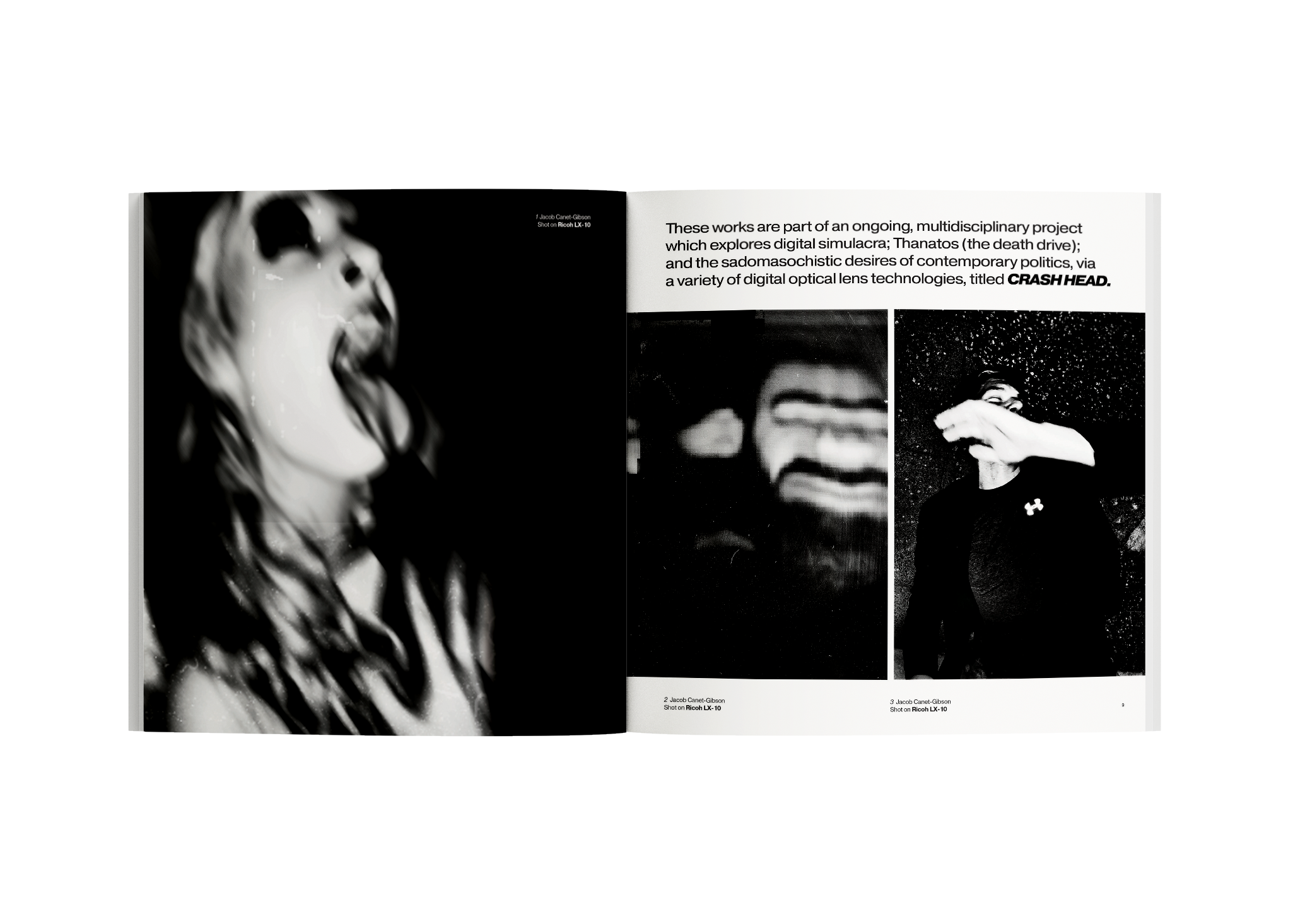
“These images combine multiple exposures, re-photographing and repeated scanning of both digital and analogue photographs… Primarily edited via coding software and photographic data files. I am unable to see the photographs as they are created and modified — resulting a new kind of digital darkroom.”
Where did this project begin for you?
“I hadn't worked with analogue photography in a while and was also in the process of wrapping up my PhD when I was working on these artworks, so I was reflecting on the last decade my practice.
With this in mind, I was interested in intersecting my current, digital and data based practice, with the analogue processes I first learnt many years prior. I was curious to see if these two differing methodologies could work alongside one another and arrive at novel results.”
How did you approach making the work?
“Using the film, I took a series of very textural experiments. I also selected a series of digital photographs from the last decade of my work. I then sandwiched small prints of these digital images and the negatives in the scanner together.
The resulting scans I then edited entirely via their data or code, editing the images without being able to see them visually. The final works have a combination of analogue texture and grain alongside simultaneously having pixelation and low resolution degradation.”
What were you hoping the work would hold?
“I wanted to see if I could produce images that appeared both analogue and digital simultaneously and via these conflicting properties engage in a kind of Verfremdungseffekt and ostranenie with the history of both the medium and my own practice.”
How would you describe your practice?
“My practice is focused on deconstruction and the brute forcing of technology to produce novel results. I work across photography, video, installation and sound. I'm especially interested in employing experimental, research-driven methodologies based in postmodernism and critical theory to post-documentary stories. Basically, extreme art practices for extreme subject matters.”
Jacob’s work has been exhibited by Spectrum Arts Space and PCP (Australia), and produced internationally through USST (China). In 2020 he was awarded Australasian emerging documentary photographer of the year, and his doctoral research has been shown at STILL: The National Still Awards, CLIP (Australia) and Revelation International Film Festival. His work is held in private collections in Australia and Japan.
What’s inspiring you creatively right now?
“My work is often preoccupied with examining how optical lens technologies mediate our perception and how that mediation can itself be exploited as a material for art-making. My work is also centred around the personally-sensed, tied to my own encounters and experiences in Oceania.”
Right now, that interest is shifting further into sound and data.
“At the moment I'm mainly focused on researching into music composition and data. I'm hoping to develop some ways to write compositions with photographic hexadecimal information.”
What’s next?
“I have an upcoming group show in early 2026 — REDACTION TOOLKIT — with Harrison Waed See, Stirling Kain & Jordee Stewart.
I'm also working a lot of on sound at the moment with two projects coming out in the near future — one with Vegas-based electronic music producer Butterscotch Tate and another with Bryant Davis, an Austin-based, musician who primarily works in post-hardcore, metal and noise(rock).
I'm also been accepted as part of this year's enuntiatio.praefatio.formulae II residency, working on collaborative experimental compositions and research for ensembles in Slovenia.”
Jacob’s current body of work sits inside a larger ongoing project titled CRASH HEAD — exploring digital simulacra, the death drive, and the desires embedded in contemporary politics through optical lens technologies.
Flash. — Exhibition & Issue 03 Launch
Flash. Issue 03 One-week-only exhibition:
19 — 25 January 2026
10am to 4pm daily
Terrace Greenhouse Gallery
223 South Terrace, South Fremantle, WA
Free entry
Project See & B is dedicated to amplifying under-represented voices in the creative industry. Issue 03 was made possible thanks to the support of The Blackbird Foundation.